
podcastmarketers
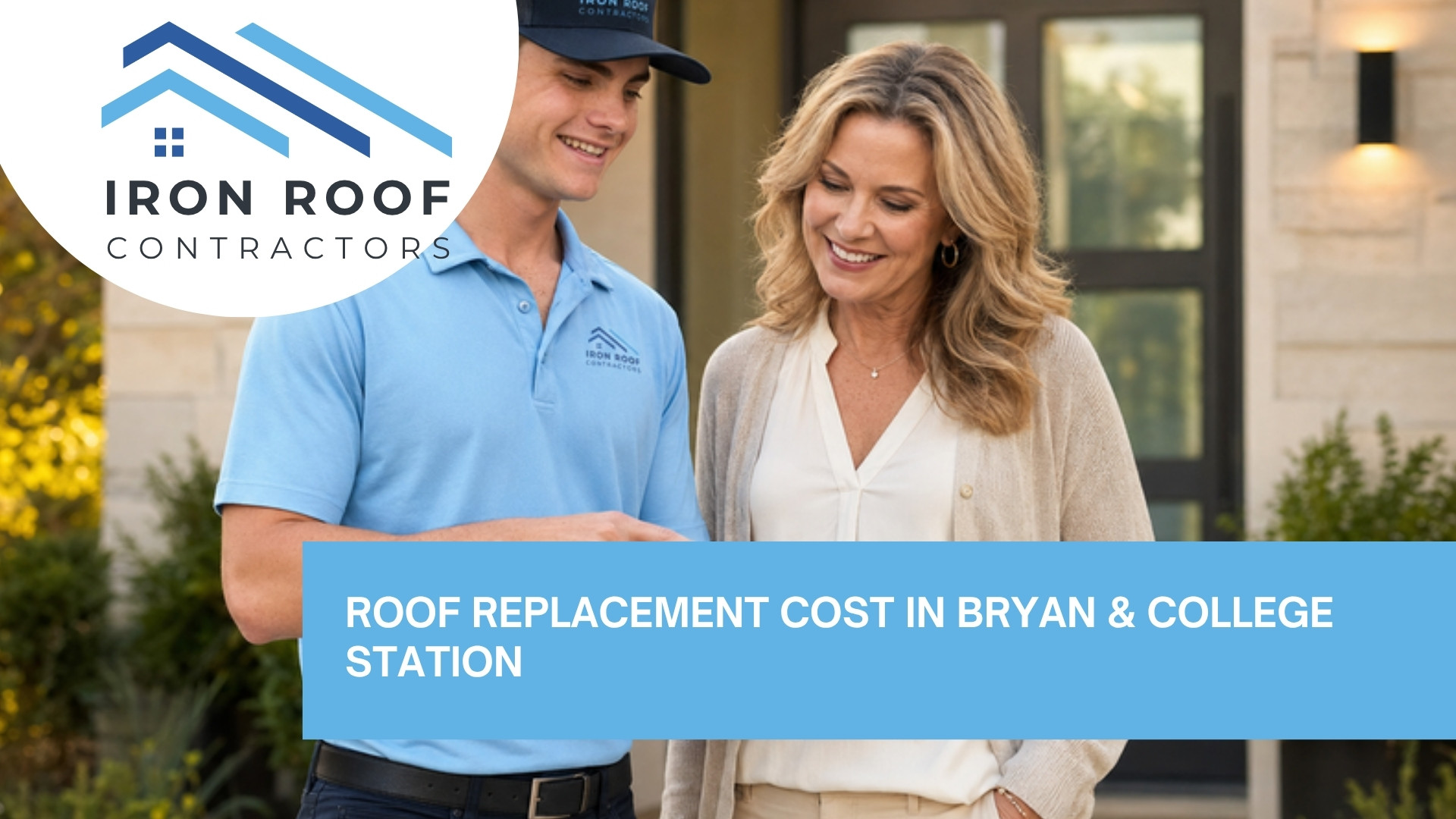
If you’re pricing a new roof in Bryan, College Station, or anywhere in the Brazos Valley right now, you’ve probably already noticed something frustrating: every contractor gives you a different number, and most of them won’t tell you why.
Here’s the straight answer.
In 2026, most Brazos County homeowners are paying somewhere between $5,700 and $14,000 for a residential asphalt shingle roof replacement. Metal roofs typically run double. The spread inside that range depends on the size of your roof, the pitch, the condition of the decking underneath, the materials you choose, and how complex the cut-up is (chimneys, valleys, dormers, etc.).
That’s the short version. The rest of this guide breaks down what those numbers actually mean — so when you sit down with a roofer, you can read the line items instead of guessing.
Key Takeaways
- Average asphalt shingle replacement in Brazos County: $5,700 to $14,000 for a typical home.
- Standing seam metal roof in Texas: $8 to $14 per square foot installed in 2026 — roughly double asphalt.
- Steep or complex roofs cost 20% to 50% more than simple single-story ranches of the same square footage.
- Rotted decking adds $40 to $60 per sheet plus labor — and you usually don’t find out until tear-off.
- Texas hail/wind deductibles are typically 1% to 2% of your home’s insured value — that’s $3,500 to $7,000 on a $350,000 home, not the $1,000 you may have on your policy elsewhere.
- The cheapest quote is almost never the same scope of work as the most expensive one.
What a Roof Replacement Actually Costs in the Brazos Valley
Roofers price two ways: per square (one “square” = 100 square feet of roof surface), or per square foot. We’ll use per square foot here because it’s easier to map to your home.
2026 installed prices, Brazos Valley
| Material | Cost per sq ft (installed) | Typical total — 2,000 sq ft home |
|---|---|---|
| 3-tab asphalt shingles | $3.00 – $4.50 | $6,000 – $9,000 |
| Architectural (dimensional) shingles | $4.25 – $7.00 | $8,500 – $14,000 |
| Designer / impact-resistant shingles | $6.00 – $9.00 | $12,000 – $18,000 |
| Corrugated metal panels | $5.00 – $8.00 | $10,000 – $16,000 |
| Standing seam metal | $8.00 – $14.00 | $16,000 – $28,000 |
Those numbers are installed — material, labor, underlayment, flashing, basic ventilation, removal of the old roof, and dump fees. A bare-bones quote that excludes any of those is not an apples-to-apples comparison.
For most homes in Bryan and College Station, the realistic middle of the road is an architectural shingle roof in the $10,000 to $14,000 range. That’s the product 80% of our neighbors end up with, and it carries a 25- to 30-year manufacturer warranty.
What Drives the Price Up (and Down)
Two homes on the same street can have a $4,000 swing in roof replacement cost. Here’s why.
1. Roof size and pitch
Bigger roof, more material and more labor. That part is obvious.
Pitch is the part most homeowners miss. A roof with a steep slope — anything over 6/12 — adds 20% to 40% in labor because crews work slower, need additional safety equipment, and physically can’t carry the same load up a steep deck. Two-story homes with steep cuts will price meaningfully higher than single-story ranches even at the same square footage.
2. Decking condition
When the old shingles come off, the plywood or OSB underneath gets inspected. If it’s rotted, water-damaged, or structurally weak, it has to be replaced before new roofing can go on. That’s typically $40 to $60 per sheet plus labor.
You won’t know until tear-off. A good contractor includes a contingency line in the estimate for likely decking replacement — usually 1 to 5 sheets — so you’re not surprised. If they don’t, ask.
3. Roof complexity
Multiple slopes, valleys, dormers, skylights, chimneys, satellite mounts, attic vents — every penetration is a place where flashing has to be cut, sealed, and integrated. A complex roof with steep pitches, multiple penetrations, and three stories can cost 30% to 50% more than a simple ranch of the same square footage.
If your home has a clean gable design with two slopes and a single chimney, you’re on the lower end. If you have a hip-and-valley design with three dormers and a wraparound porch, expect the high end.
4. Material upgrade choices
The shingle itself is usually the smallest line item swing. The bigger upgrades that move the total:
- Synthetic underlayment vs. felt (~$300–$600 extra; worth it in Texas heat)
- Ice & water shield at valleys and penetrations (~$400–$800)
- Ridge ventilation upgrade (~$200–$500; pays back in attic temperature)
- Drip edge on all eaves and rakes (should be standard — confirm it is)
- Impact-resistant Class 4 shingles ($1,500–$3,000 extra; often returns a 10–25% insurance discount in Texas)
5. Where the crew comes from
A local Brazos Valley crew that drives 15 minutes to your house has lower overhead than a storm-chaser company hauling equipment in from Houston or DFW. That can show up as $1,000–$3,000 of price difference, and it also shows up as response time when there’s a warranty callback two years from now.
Insurance: How It Changes What You Actually Pay
In Texas, most roof replacements happen after a hail or wind event, and insurance covers most or all of the cost minus your deductible. Here’s what you need to know in 2026.
Texas uses percentage deductibles
Most Texas homeowners insurance policies now apply a 1% to 2% wind/hail deductible based on the home’s insured value, not a flat dollar amount. Some carriers in higher-risk areas have moved to 3%.
What that looks like in real numbers:
| Home insured value | 1% deductible | 2% deductible |
|---|---|---|
| $250,000 | $2,500 | $5,000 |
| $350,000 | $3,500 | $7,000 |
| $500,000 | $5,000 | $10,000 |
Pull your declarations page. Look for “Windstorm or Hail” — the deductible there is what you’ll actually owe out of pocket if a covered claim approves a full replacement. Most homeowners are surprised the first time.
What insurance pays for
Insurance pays when:
- Damage is caused by a covered peril — typically hail, wind, or a fallen object.
- The damage meets the carrier’s threshold. For hail, adjusters use a 10×10 ft test square and count impact marks. Seven to ten hail marks in that square typically justifies replacement.
- You filed a claim and notified your carrier before major repairs were made.
Wear, age, granule loss from sun exposure, and poor maintenance are not covered. Neither are “cosmetic only” hail marks under some endorsements — read your policy.
What insurance doesn’t pay for (but should be in your scope)
Code upgrades. When your roof was originally built, ventilation, flashing, and drip edge standards may have been weaker than current code. When you replace, the contractor typically has to bring it up to current Brazos County and City of Bryan/College Station code. Some policies include “ordinance and law” coverage; many don’t.
If you’ve had hail damage and want help reading your policy, our Storm Damage & Insurance Restoration team can walk you through your declarations page before you file.
What to Ask Any Roofer Before You Sign
Three questions, asked in this order, will separate the real bids from the lowball ones.
1. “What’s your decking allowance?”
Good answer: “Two to five sheets included; anything beyond that is $X per sheet.”
Bad answer: “We’ll see when we get up there.”
The first answer means the contractor has done this enough to estimate accurately and you won’t get a surprise change order on install day.
2. “Are you a manufacturer-certified installer?”
Good answer: Yes, with a specific name — GAF Master Elite, Owens Corning Platinum, CertainTeed SELECT ShingleMaster.
Bad answer: A vague “we install all major brands.”
Manufacturer certification matters because extended warranties — the ones that actually cover labor, not just material — are only honored when installed by a certified contractor. Without certification, you get the limited base warranty.
3. “Can I see your workmanship warranty in writing?”
Good answer: A document, with terms, that survives the install crew leaving.
Bad answer: “Oh, we stand behind our work” — verbal only.
Material warranties come from the manufacturer. Workmanship warranties come from the contractor. If the workmanship warranty isn’t in writing, it doesn’t exist. (Our written workmanship warranty is on every contract — read more on the Residential Roof Replacement page.)
How Iron Roof Co Quotes a Roof
We do this differently than most roofers in the Brazos Valley, and the cost guide above is the reason why.
When you book a free estimate, we generate a detailed line-item quote using our AI-powered measurement system — square footage, pitch, complexity factor, material spec, decking allowance, flashing, ventilation, and dump fees all itemized. You get the breakdown, not a single bottom-line number you can’t pressure-test.
We don’t pressure. If your roof has five more good years on it, we’ll tell you that and walk away. If insurance owes you a full replacement, we’ll help you read your policy. If a competitor’s $7,000 quote is actually a better fit for your situation than our $11,000 quote, we’ll point that out too.
That’s what father-son means for us. Read more about how we work.
Frequently Asked Questions
What’s the average cost of a roof replacement in Bryan or College Station?
Most Brazos County homeowners pay between $5,700 and $12,000 for a standard asphalt shingle replacement. A 2,000 sq ft home with architectural shingles typically lands around $10,000 to $14,000. Metal roofs run roughly double.
How much per square foot is a new roof in Texas in 2026?
Asphalt shingles run $3 to $7 per square foot installed. Standing seam metal runs $8 to $14. The wide range comes down to roof pitch, complexity, decking condition, and which manufacturer system is installed.
Will insurance cover my roof replacement?
Insurance pays when damage is caused by a covered peril like hail or wind, and the damage meets the carrier’s threshold (typically 7 to 10 hail marks per 10×10 ft section). Wear, age, and poor maintenance are not covered. Most Texas policies use a 1% to 2% wind/hail deductible — on a $350,000 home that’s $3,500 to $7,000 out of pocket.
How long does a roof replacement take?
Most asphalt shingle replacements on a typical Brazos Valley home are completed in one day. Larger homes, complex roofs, and metal or tile systems take two to three days.
Why are estimates from different roofers so different?
Three reasons: scope (some include decking, flashing, and ventilation upgrades; others don’t), materials (3-tab vs architectural vs designer), and crew quality. A $7,000 quote and a $14,000 quote are rarely the same roof. Always compare line items, not totals.
Ready to Get a Real Number on Your Roof?
You’ve now got the framework. Square footage, pitch, complexity, decking, material, and insurance — those six levers explain almost every roof quote you’ll ever see.
If you want a transparent, line-itemed estimate for your home in Bryan, College Station, or anywhere in the Brazos Valley, we’ll come measure, inspect, and put it in writing. No pressure, no upsell, no surprise change orders.
Or call us directly at the number in the header — same crew, same answer either way.